

Airing Up: 12v heavy duty air compressors
written by Fred Ginsburg
We recently upgraded our portable 12v air compressor that we use for airing up all of our tires at the end of a run.

Smittybilt 2781 air compressor, 12v 5.6 CFM
The unit that we were using was the very popular Smittybilt 2781, which puts out 5.6 CFM worth of air. As discussed in our 101 Basics series, you really do not want to use an air compressor rated less than 5 CFM (cubic feet per minute) for inflating large offroad tires. At the time we purchased it (2021), it was “state of the art” and did a noble job of inflating our then 33” all terrain tires, as well as our current 35” tires.
However, offroading is like any hobby: you just keep upgrading! Now that we are Trail Leaders, it has become more important for us to be able to air up in less time, so that we can assist others as they air up.
Prices for good air compressors has come down, so it seemed like a good time to step up our game.
The first thing that Fred wanted was a faster, more powerful system. 5.6 CFM works well, but 10+ CFM will get the same job done in half the time. These days, you can shop around and find dual cylinder air compressors from the leading manufacturers that are rated in the 12’s — at only a slight bump in price than the traditional 5.6’s. We upgraded to an All Top, which is rated 12.3 CFM with a digital controller.
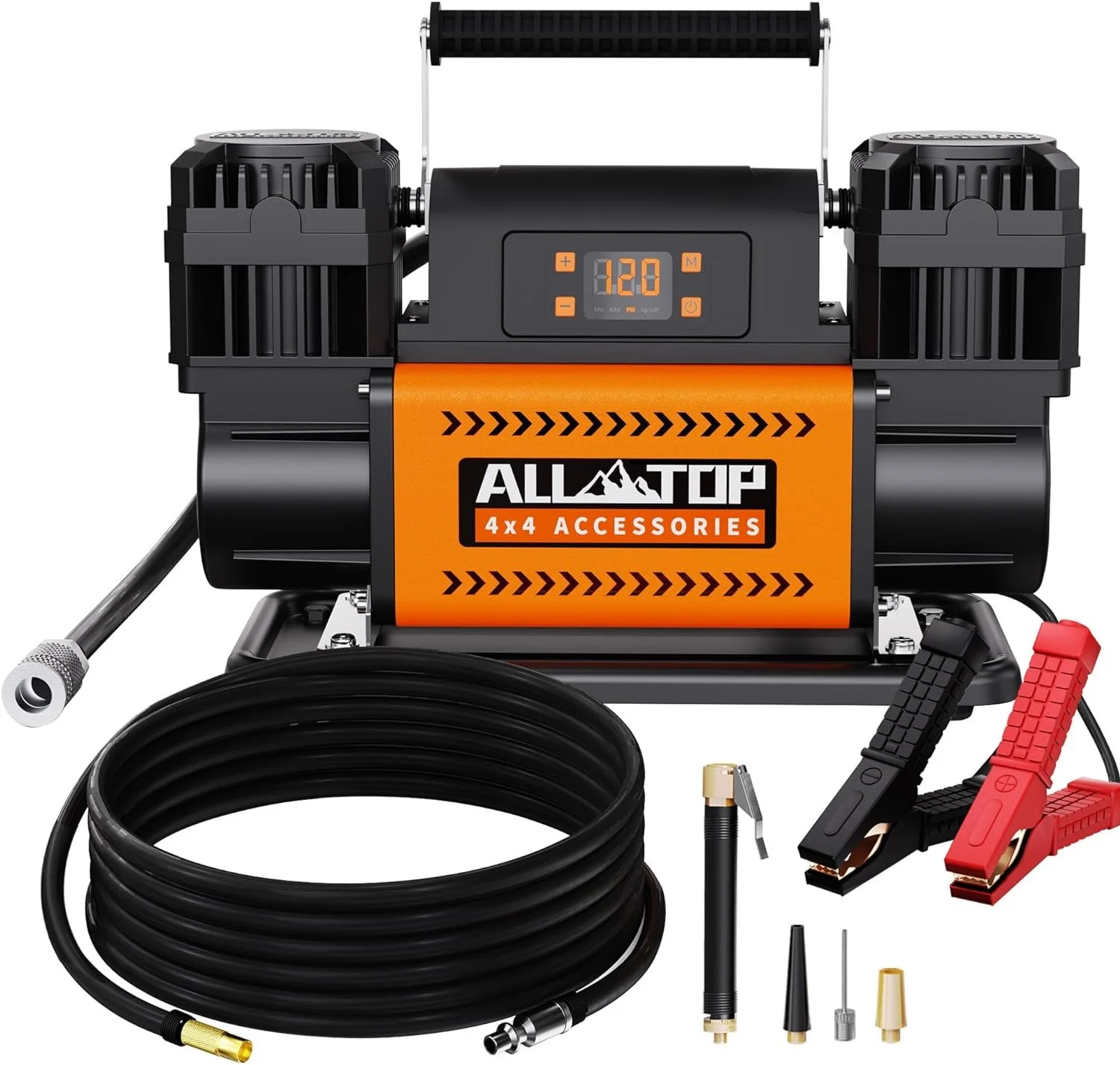
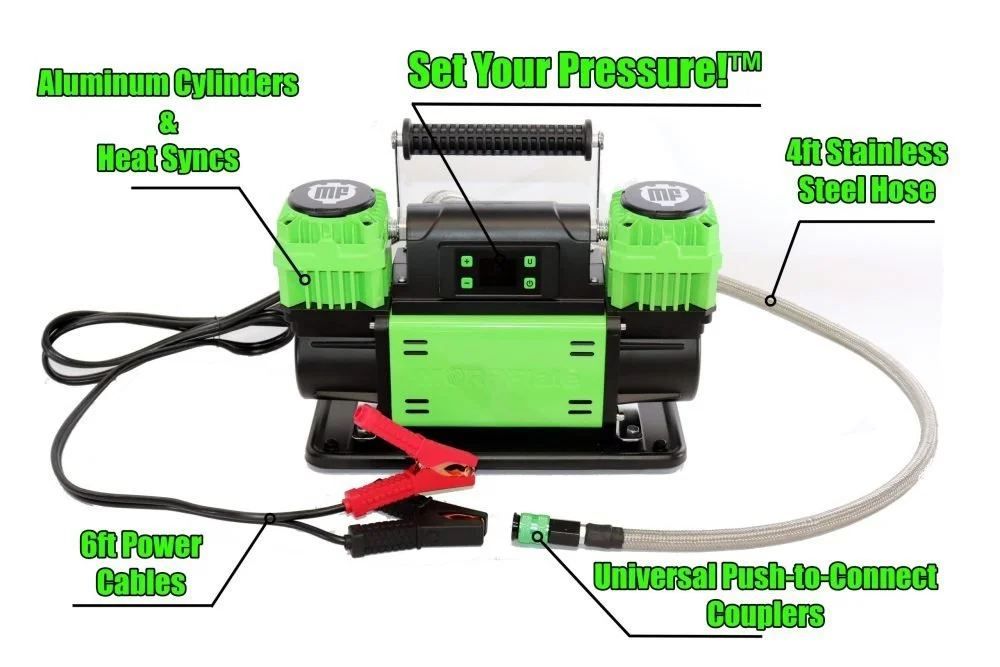
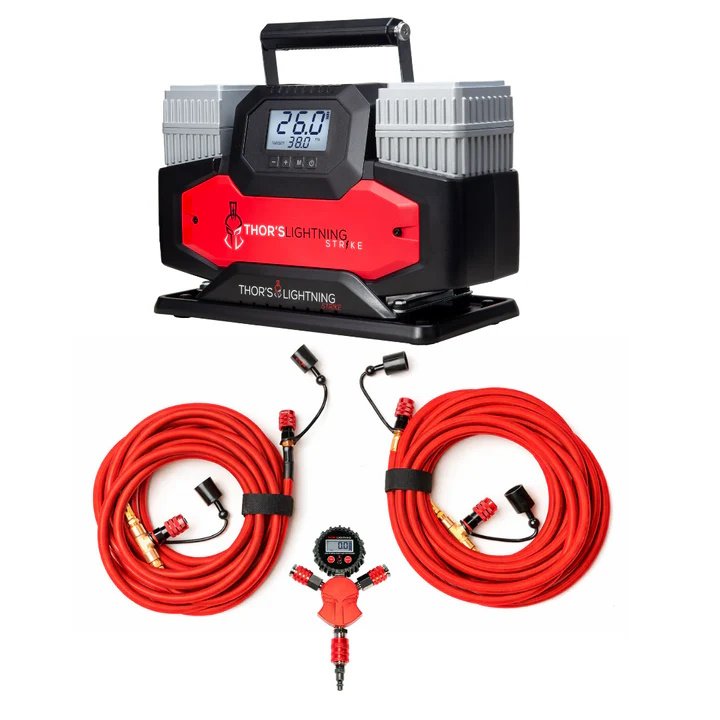
Popular compressors shown left to right: All Top, Morrflate, and Thors Lightning.
Another feature that is well worth the increase in cost is a digital controller, not to be confused with merely a digital tire gauge. The digital controller allows you to set a target psi, and the unit will automatically shut off when that tire pressure is attained. This really simplifies the airing up process, since you no longer have to be a slave to a handheld tire gauge, nor be glued to the tire pressure readout on your dashboard.
In our instance, we were lucky for our Jeep to have come from the factory with the “tire fill assist” option in our Settings. When we air up, the Jeep will honk when a tire attains a pre-set tire pressure (36 psi in our case), alerting us to turn off the compressor and move to the next tire. But not all Jeeps came with that option, due to chip shortages.
However, by having a digital controller built into the air compressor, there is no need for dashboard or tire-kneel handheld monitoring. Set it, forget it, walk away and socialize. The compressor will stop on its own. That is truly a game changer worth the extra money!
Although there are several manufacturers of these dual cylinder, digital controlled, portable 12v compressors on the market — examples of the most recognized brands include Thors Lightning, Morrflate, and All Top. The same factories also OEM (white label) similar products to other retailers, so it pays to shop around and do some internet research.
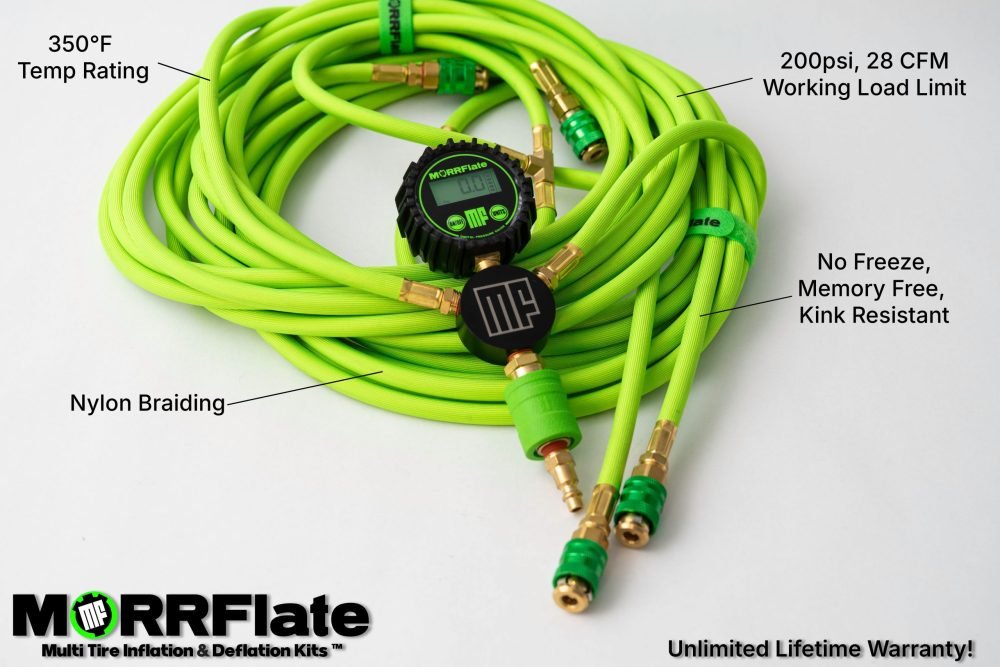
Two-tire and four-tire hose systems can be purchased separately from vendors.
Another feature to consider is to add a 4-hose system to your heavy duty compressor. Most of the time, these 4-tire systems consist of two hoses, each with a branch to connect to both tires on either side of the vehicle. One hose for each side, two connecting branches per hose. The two main hoses then join onto either side of a central valve unit, which is a Y configuration. The bottom of the Y would then connect to the air feed from the compressor. This system allows you to inflate all four tires simultaneously, and to achieve equal pressure in all four. You can also use the four-hose system and the Y connector to simultaneously air down the four tires.
Just to confuse the issue, sometimes you can opt for just a two-tire hose system, which is one less hose to worry about.
Do these four-hose systems save time and effort? Maybe.
Inflating four tires simultaneously, compared to inflating four tires singly, is a little bit faster in terms of “air compressor running” elapsed time. It shaves a couple minutes, but not a lot. What eats up the rest of the time is the process of moving your air hose every couple of minutes from tire to tire, and then restarting the compressor.
On the other hand, the initial set-up of the four-hose system takes longer. You need to unpack and untangle the hoses. You still have to go around to each tire and hook up the hoses. Then you need to connect the hoses to the central hub, and then connect the hub to the compressor. Hoses need to be uncoiled and laid out; and then re-coiled and put away. However, once you set up the four tires, you can stand back and relax for several minutes.
Is it faster and easier? I think that it comes down to personal preference and style.
For right now, Gaye and I prefer the simpler (and less stuff to transport) single hose, single tire at a time, approach. But that’s just our choice for now. Who knows, we might change our minds later on and spring for a 2-tire or 4-tire hose system.
You will have to decide for yourself if you desire a single hose, or a two-tire setup, or four-tire setup. The good part is that you can make that decision at a later time; and that a hose system does not have to be the same brand as your compressor. One word of caution, however. Some compressors use rare Asian style fittings (example: Smittybilt), while other brands use standard (found in any hardware store) fittings.
“Features to look for in a serious 12v portable air compressor... Dual cylinder. A CFM rating of ten or higher. A digital control panel that allows you to set a target PSI. Heavy duty battery clamps, at least 6 foot. An air hose long enough to reach all four of your tires. Standard hose fittings (non proprietary) so that you can use accessories from multiple vendors.”
