

Lights and Night Runs
Written by Fred Ginsburg
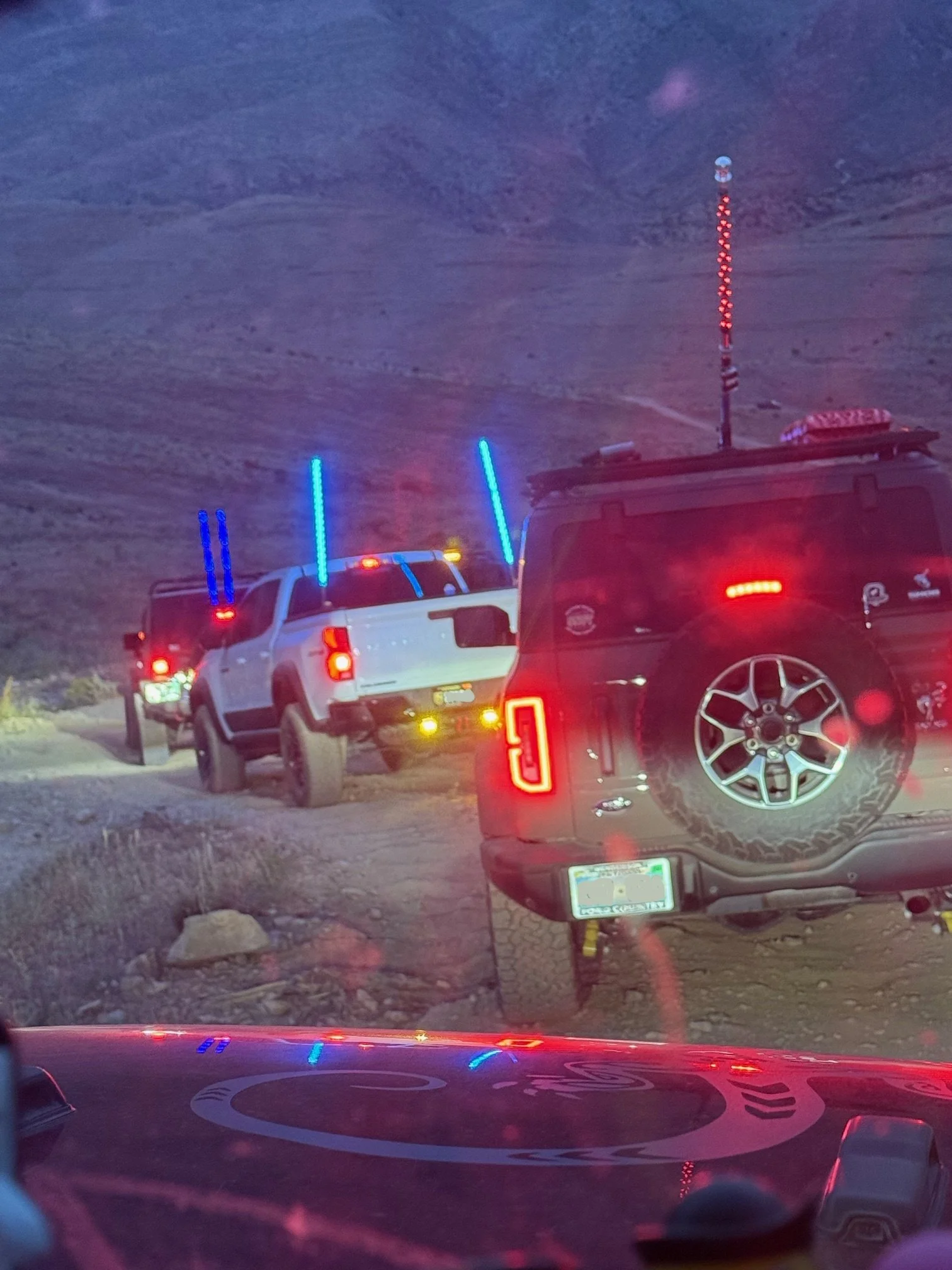
LED whip lights make vehicles stand out
Summer days often means summer hot, blistery days – which can turn a lengthy trail run into an uncomfortable ordeal. When the metal on your jeep is too hot to touch, and your cell phone and GoPro shut down due to overheating from direct sun roasting them in their dashboard mounts, and that outboard air compressor sizzles your bare ungloved palm – it might be time to postpone your offroad activities until after the sun sets.
Evening and night runs are common out here in the Western states, where daytime temps can reach 90 to 110 degrees during Summer.
Although your first several offroad trail runs should be daytime until you gain confidence and experience, night runs become a viable option during those hotter months.
Driving in the dark is a lot of fun, and not as scary or difficult as beginners might imagine. No, we do not recommend tackling trails rated for advanced rock crawlers, because depth perception is diminished on dark trails. But the flatter trails (usually rated 2 thru 4) should not be a problem.
At night, it is very important for Trail Leaders to keep their caravans tight. Since it is harder to see upcoming obstacles and road conditions, the ability to observe the lines of a couple vehicles ahead of you is beneficial.
Spotters are recommended at the more serious obstacles, or if vehicles need to maneuver or park close to steep drop-offs.
Driving at night is basically just “follow the leader”. Watch the car ahead, and follow their tire lines. Not really different than driving during daylight.
Do you need special lights?
Unless you are the Trail Leader, your standard headlights are sufficient. If yours is a newer vehicle, you probably even have extra bright LED headlights. All that you require is the ability to light up a few car lengths in front of you. We are traveling slow, and the resulting daisy chain of tail lights and headlights paints a surprisingly clear picture of your path all along the caravan.
Offroaders will be offroaders, which means that most of us will load up on accessories.
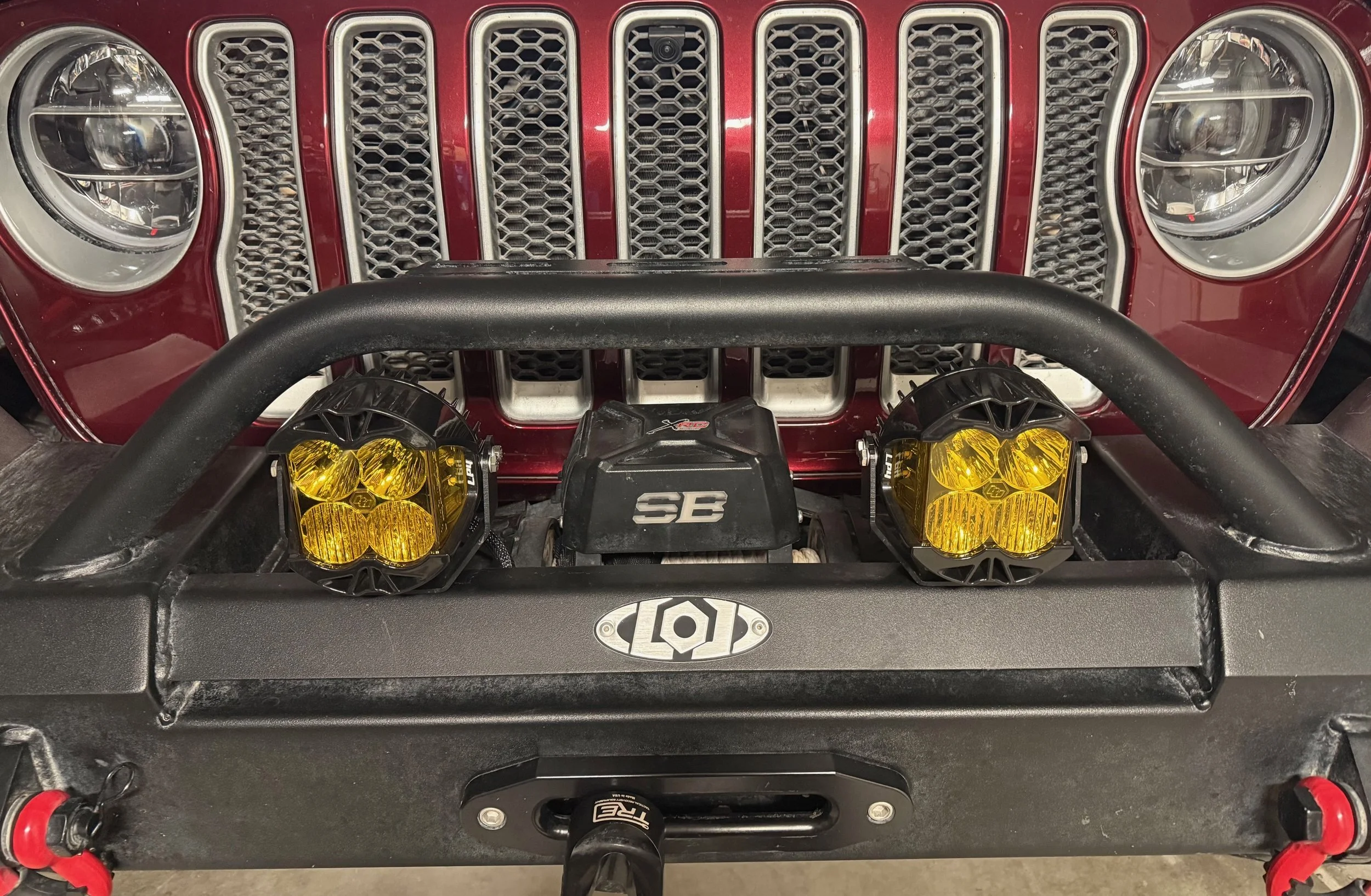
Baja Designs LP4 quad cluster LED lights
Light bars, triple & quad clusters, and single auxiliary units will provide additional frontal illumination. The downside to these driving lights is that although they are really helpful if you are the leader, they can be distracting or blinding to the driver directly in front of you. As a courtesy, use your radio and ask the car ahead of you if your extra lights are a problem.
Our jeep is equipped with a pair of LED quad-clusters mounted on our front bumper, on either side of the winch. Each amber colored rectangular cluster consists of four LED bulbs: two direct front and two wider for side coverage. That’s a total of eight bright lights!
When we use our extra lights at night, we usually only engage them on curvy switchbacks, dusty conditions, or when the car ahead of us is barely visible. For normal caravan columns, just our standard LED headlights are sufficient.
During heavy dust, fog, and precipitation –daytime or especially at night—it is essential to see the car ahead of you. Not just in order to follow their tracks, but also to avoid rear ending them if they slow down or stop! Some sort of rear lighting is important.
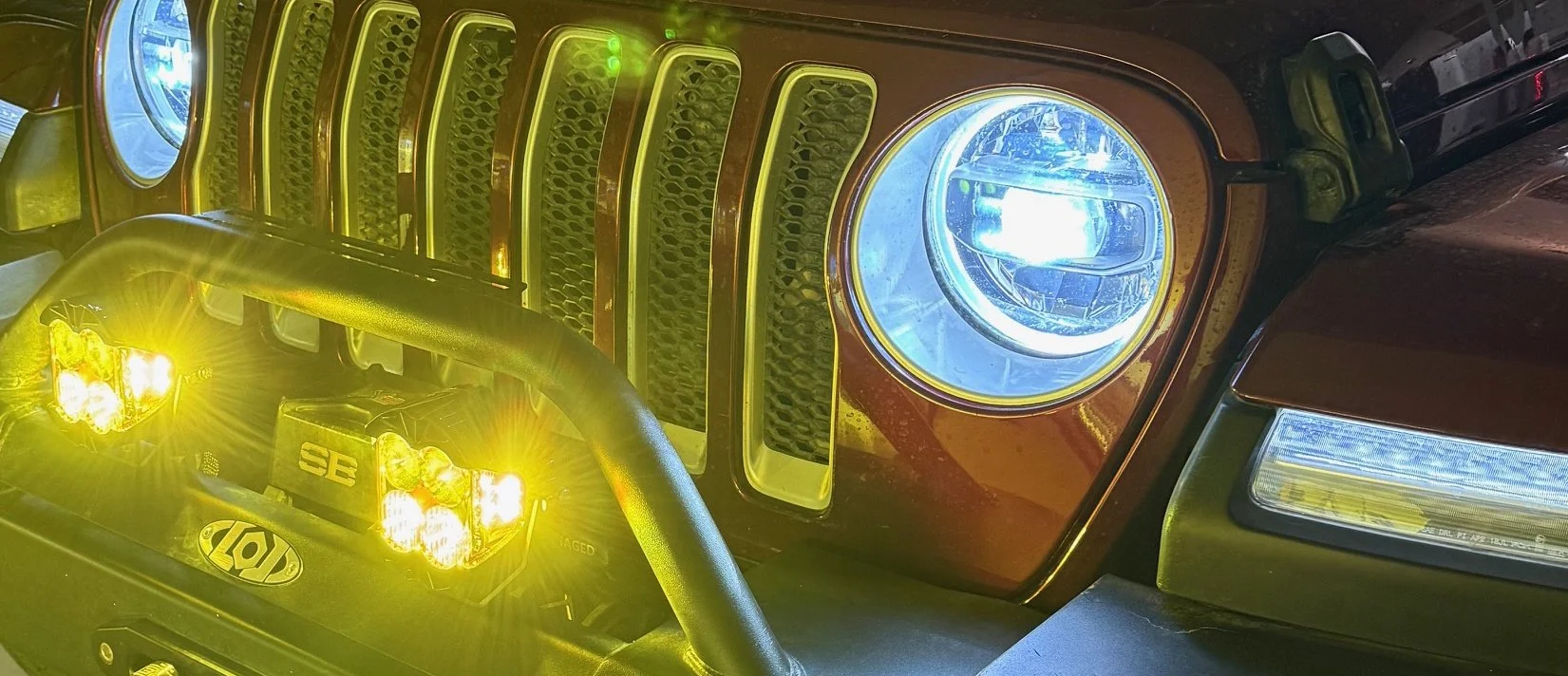
LED front 4-light clusters offer 8 bulbs total.
At the very least, drive during daylight with your headlights activated. Do not assume that the AUTOMATIC headlight setting will turn on your full headlights during daytime; you need to physically switch them on., either by turning the headlight selector knob (or by covering/blocking the small sensor dome on top of your dashboard).
To make your vehicle’s (stock) rear running light even more visible during dusty conditions, activate your emergency blinker! It will cause your brake lights to flash with greater intensity. You can turn them off when road conditions clear or improve. Inform the other drivers that you are flashing on purpose and not signaling that you are in distress.
Some vehicles install small, rear amber flashers, which really helps keep their cars visible.
LED whips
Another popular trend is to replace the thin whip flag assembly with an LED pole. Those are the light poles that resemble bug antennas and produce captivating light shows. LED whiplights enhance your vehicle’s visibility at night as well as diminished daytime conditions.
How much do these extra lights cost?
Front lights will vary, from $50 for cheaper singles up to $350 for a high quality quad cluster. Light bars also vary a lot in price, based on quality and size.
Like all products, you get what you pay for. Purchase strictly on the basis of price, and you may get a piece of junk that will fail in a few months or not survive a harsh trail. Check the consumer reviews from third parties, and do not rely on sponsored or manufacturer’s claims.
We went with Baja Design front ambers, which were pricy! Yeah, around $350 per cluster, which comes out to $700, plus installation. You don’t have to spend that much; there are lots of other good brands out there. However, do not cheap out. There is a lot of total junk on the market, so buyer beware.
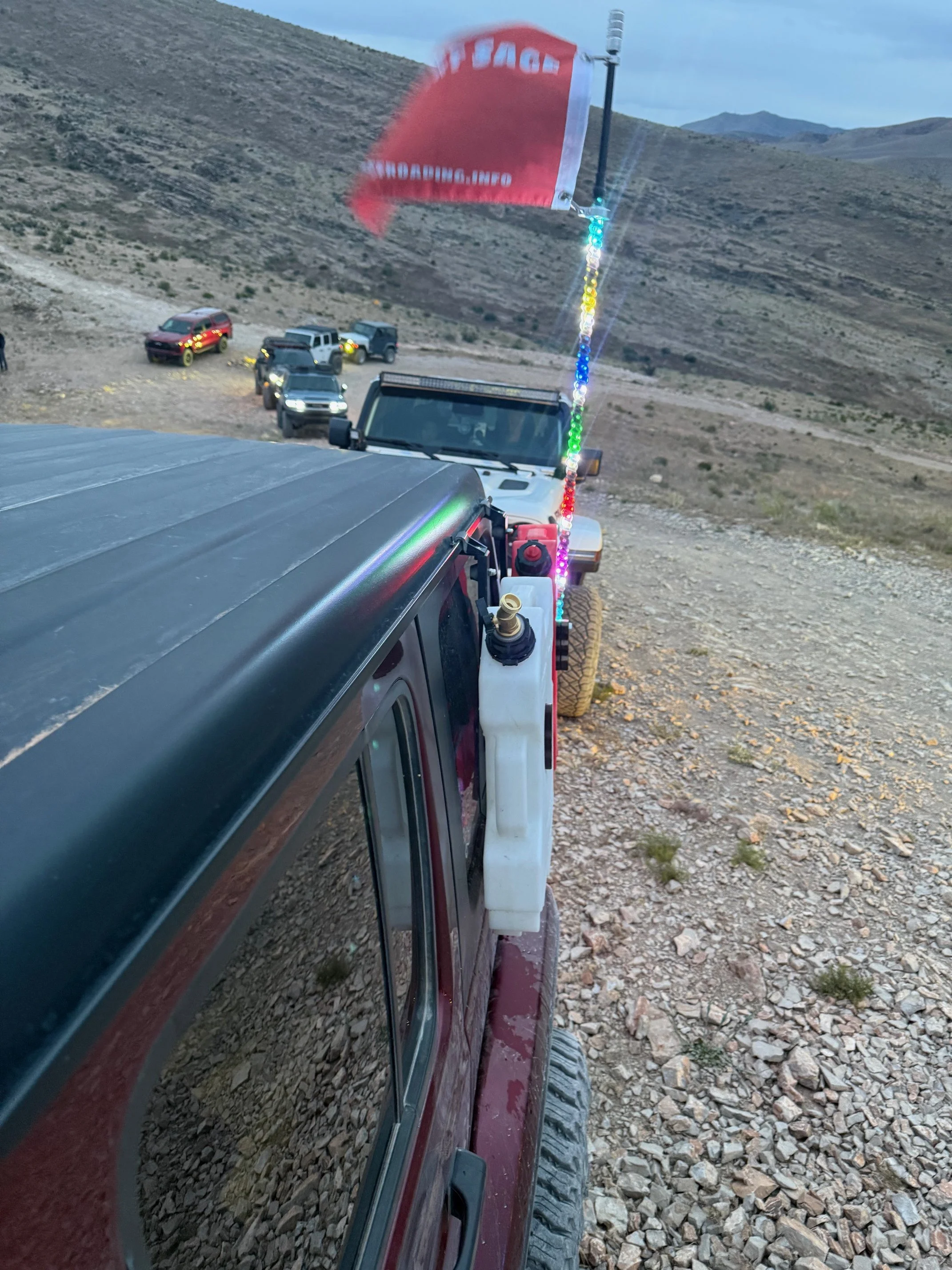
LED whip light mounted to rear corner of jeep
Same applies to LED whiplights. We went with Whip 5150, which is highly rated (and highly priced). Our six foot whip cost $300 on sale. Plus installation.
You can certainly find LED whips on Amazon and other sites from $75 up. Again, buyer beware. Cheap whiplights may snap from wind, shatter from vibration & hits against the body of your vehicle, or from foilage along the path. Electronics may fail easily, or be limited in programming options. Overall length and mounts will vary, so figure out in advance where and how you plan on sticking it.
We chose an unusual spot: on the bumper where it wraps around under the fuel cap. So technically it is on the driver side of our jeep, not directly in the rear. That allows us to access the rear hatch window and swing-out tailgate without interfering with the whip. Since we mounted at bumper height and not higher up on the spare tire bracket, we chose the long six foot version.
If you mount your whip on the tire bracket or a roof basket, shorter whip lengths (2, 3, or 4 ft) would suffice.
Think about installation & electrical wiring.
At the simplest level, the whiplight could be powered by running a cable into the storage trunk and plugged into an auxiliary 12v socket. The cable could enter via the rear hatch window or a wire port, but make sure that you can still open/close the tailgate or hatchback. Another temporary solution is to use the power outlet for your towing hitch.
We paid our mechanic to wire our lights to our Auxiliary power buttons that came with our “Towing Package”. This allows us to activate our front lights or the whiplight with a press of a button. The whiplight has a 3-pin connector that mates with the wire harness, so it is easily removable.
Lighting color?
Front lights can be “clear” or amber. Amber is the most popular for offroad driving, and is conducive for night or daytime. Do NOT use your auxiliary lights on regular highways, which may interfere with oncoming traffic. Nasty traffic citation.
Whiplights offer various moving or flashing multi-color displays. The better units can be programmed by a handheld remote controller or cell phone app.
What you do NOT want is to have any of your fixed front, rear, or rooftop lights be any color other than clear or amber. Showing red or blue lights, steady or flashing, is considered as impersonating an emergency vehicle and will result in hefty fines! Even having undercarriage “rock” lights with red or blue can get you in trouble. Regulations and enforcement vary from location to location. Never hurts to ask your local law enforcement about what is permissible in your region, but also consider that you may be traveling out of state as well.
Sometimes your UNCOVERED offroad lights may be illegal!
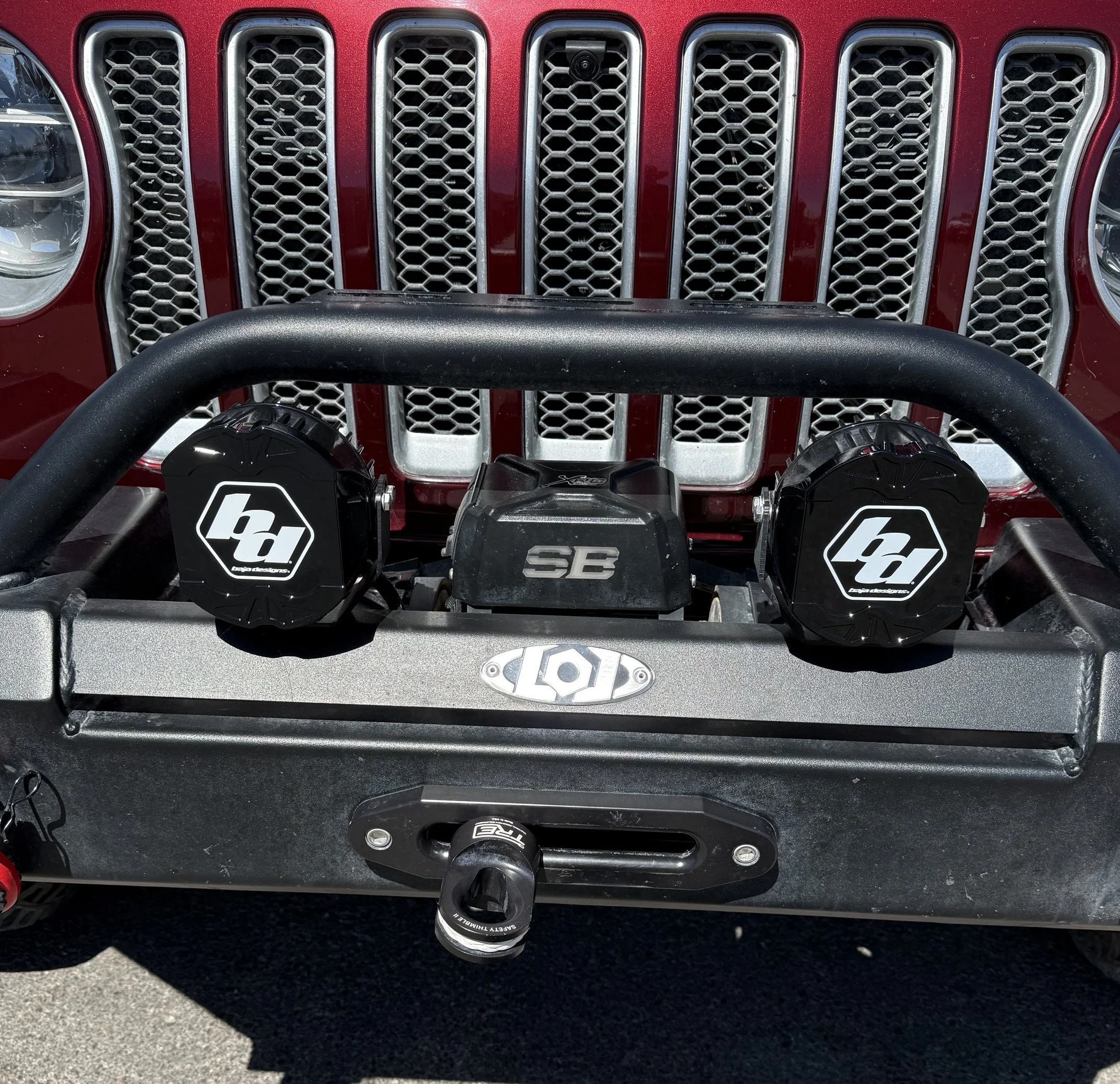
Baja Designs sells plastic covers for their lights. Better safe than sorry. But the covers also protect your investment from flying debris on highways.
Although there is no issue about using your new lights offroad, the laws do vary from state to state as to whether they need to be opaque covered when driving on a regular (not offroad) street or highway.
The first criteria is the placement (height above ground) of your auxiliary lights. In some states, so long as they are mounted not higher than 42 inches, they are okay. Lights mounted on the structural A frame, or near the top of the windshield/roof MUST remain covered on regular roads.
Lights mounted low on the vehicle, such as on the bumper, fall into a different class. The rule of thumb is that if the lights are lower than the headlights, they are okay.
Most (but not all) states are fine with lower mounted lights, so long as they are turned off and are only “clear” or “amber” color. Red, Blue, and Green are considered emergency vehicle colors and can get your cited.
Several states do not make any exception for low mounted lights (such as California).
Some states count the number of lights. Each pod is considered as ONE, even though it is made up from a cluster of four LED’s, because they are in one single housing with single wiring. Those states allow a total of four lights (which includes your two headlights). However, some laws do not count LED bar lights as a single pod, and count all of its component LED’s. Politicians hate making the laws easy to understand!
We recommend that you do a Google or AI inquiry to verify local regulations in your state, as well as any states that you plan on driving through.
Personally, we purchased the manufacturer’s opaque covers for our two light pods to keep on the shelf just in case we do a multi-state road trip. You do not need to get expensive custom or OEM covers, just anything to go over them. Heavy material (black cloth, canvas, etc) and some velcro or strapping will suffice; make sure the covers can sustain the wind from high speed driving.
If you believe internet comments, the highway patrol rarely pull people over only for uncovered lights. However, if they do stop you for any other reasons, they are likely to add a lighting citation to the offenses. Also remember that some states require annual safety/smog inspections, and might fail your vehicle for uncovered lights.
Why take a chance? Buy or make some covers!
Editors Note: Here is what Google AI told us when we asked it about the legality of driving with two, bumper height, aftermarket LED light pods.
“You can legally drive your Jeep with your Baja Designs LP4 lights mounted on the front bumper in all 50 states.
However, the exact conditions required for them to be considered "street legal" while driving on public highways divide the country into two main groups.
Because your setup is a single pair (2 pods) mounted on the bumper, it automatically complies with standard height limits and lamp count restrictions nationwide.
The comprehensive list below details how to legally drive with your LP4 lights across the United States.
Group 1: States Where You Can Drive UNCOVERED (But Turned Off)
In these 33 states, you can legally drive on public pavement with your bumper-mounted LP4 pods uncovered, provided the main high-output off-road lights remain completely turned off.
Alabama
Alaska
Arizona
Arkansas
Colorado
Delaware
Florida
Georgia
Hawaii
Idaho
Illinois
Indiana
Iowa
Kansas
Kentucky
Louisiana
Michigan
Minnesota
Mississippi
Missouri
Montana
Nebraska
Nevada
New Hampshire
New Mexico
North Carolina
North Dakota
Ohio
Oklahoma
South Carolina
South Dakota
Tennessee
Texas
Utah
Wisconsin
Wyoming
Group 2: Conditional "Headlight Height" States (Uncovered on Bumper)
In these 2 states, you can legally drive with the pods uncovered only because they are mounted on your bumper. If you move them to your roof or A-pillars, they must be covered.
New Jersey: Uncovered off-road lights are legal on public roads as long as they are physically mounted lower than your factory headlights.
Virginia: State law allows you to keep them uncovered on the bumper, provided they are wired to automatically shut off when your low beams are active.
Group 3: States Where You MUST Use Opaque Covers
In these 12 states, driving on a public highway with non-DOT/SAE approved off-road lighting uncovered is a traffic violation. In these jurisdictions, your LP4 lights are only legal if you snap on a pair of solid plastic shields (like the official black rock guards):
California
Maryland
Massachusetts
New York
Pennsylvania
Rhode Island
Oregon
Washington
West Virginia (Mandated if mounted higher than 42 inches, but heavily enforced on modified Jeeps)
Note on New England/Mid-Atlantic: Connecticut, Maine, and Vermont technically allow uncovered bumper lights by letter of law, but local law enforcement frequently issues fix-it tickets unless off-road lights are explicitly covered.”
